
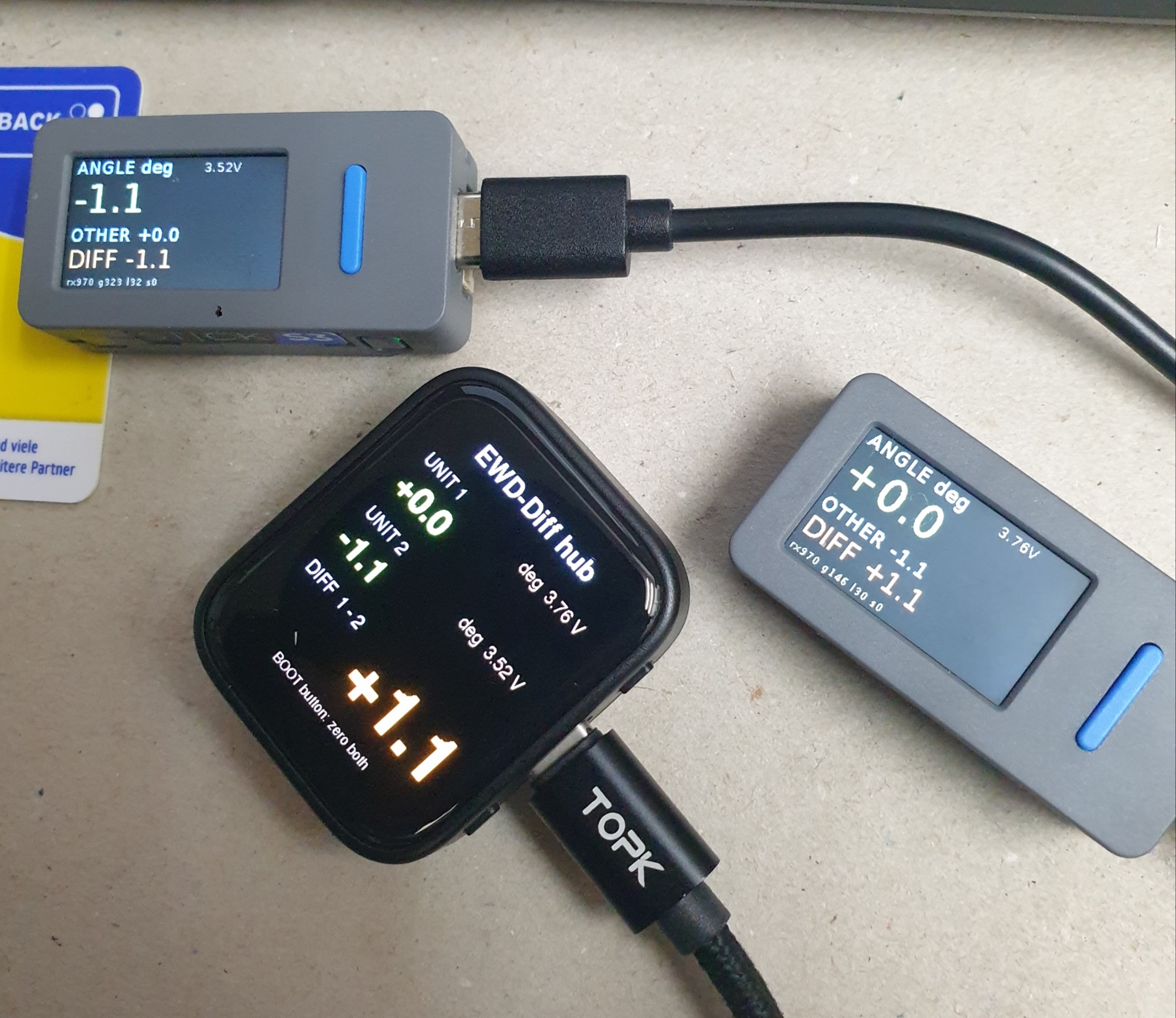
Decalage, the angular difference between the wing and the horizontal stabilizer incidence. Since I live in Germany I, I called the boxes: EWD-Diff. This project is a 2 (or 3) unit control-surface deflection meter on a pair of M5Stack StickS3. The optional third unit is a Waveshare board I had on the bench.
The project started from an idea by Pierre Rondel. A couple of months ago I had done some work on a similar thing, but my earlier version used a standard ESP32-C-something with a separate display and IMU.
I found it almost impossible to get a good resolution below 0.1 degree with those simple parts. Pierre showed a solution with the StickS3, so I thought: why not give it a try? I already know the limits of the chips, so let’s make things easy.
One thing I keep telling myself: a carpenter looks at a chair and says, “I can make one like that, but mine will have twirly legs.” Is that copying an idea, or is it a good idea cooked into my own version? The world has changed, and our AI tools are now the saw, hammer and chisel. I should stop worrying about whether I copied an idea or created it myself. I use the tools, my version does what I need, and if anyone is interested, they can have my code. Anyone who can understand this setup will have no problem making their own version anyway. It took me an afternoon, from never having used M5 parts to “oh, works nice”. Writing this up already takes me longer than building the thing.
What it does
Each M5Stack StickS3 (ESP32-S3 with a BMI270 IMU) measures the angle of the surface it sits on. It shows the angle in degrees, or in millimetres of deflection at a chord length you set. The two sticks talk to each other over ESP-NOW, so no router or WiFi network is needed. Each stick shows its own value, the other stick’s value, and the difference.
An optional hub (Waveshare ESP32-S3 Touch AMOLED 1.8) shows both units and the difference on one larger screen. Its BOOT button zeroes both sticks. Each stick averages one second of its own reading, so you do not touch the control surfaces. I really wanted this, because pressing “Zero” on the measuring unit always moves it. With the small angles we try to measure, you then never get it right.
The units pair themselves. After power up, they start looking for a friend. (and no, I have no idea what happens when I have a dozen powered on at the same time. Not today, not relevant in my workshop. )
The behavior of a single meter follows the RC Throw Meter firmware by Planet-Soaring.com, available through M5Burner: https://burner.m5stack.com/LG5ZEZ. My firmware is a clean-room build, as they say. It adds the two-unit difference display and the hub.
Status: Works for me, on my bench. No guarantees. This is not a finished product. It is Arduino code for the M5Stack and Waveshare boards, flashed with esptool.
Features compared
| Feature | Mine (EWD-Diff) | Reference (RC Throw Meter) |
|---|---|---|
| Units | 2 sticks, plus an optional hub | 1 stick |
| Splash | 2 s | 5 s |
| Orientation page | None. Always pitch (long axis X, USB end up = positive) | VERTICAL (pitch) or HORIZONTAL (roll), chosen with B and confirmed with A |
| Modes | Angle (deg) or chord (mm) | Angle (deg) or chord (mm) |
| Chord range | 20..200 mm, 1 mm steps | 20..999 mm, 1 mm steps |
| Chord entry | B tap = +1, hold = fast up. Hold A and press B = -1, hold = fast down | B tap = +1, hold = continuous |
| Setup navigation | A starts the measurement. Hold A in chord entry goes back to mode | A is next or start. Hold A goes back to MODE |
| Angle filter | Complementary: gyro plus accelerometer, time constant 0.3 s moving and 1.0 s still | 1 s moving average of the acceleration vector |
| Zero | 1 s average of own pitch, on entering the measure page. A re-zeros | Captured from a 1 s window on entering the measure page. A re-zeros |
| Remote zero | Hub BOOT button zeroes both sticks, so nobody touches the control surfaces | None |
| MAX / MIN peaks | None | Yes, reset with A |
| Sign reversal | Hold B on the measure page (shows REV) | None |
| Back to mode | B click | B |
| Other unit | Shows OTHER value and DIFF (own minus other). UNITS? when one stick is in angle mode and the other in chord mode | None |
| Link | ESP-NOW broadcast, channel 1, no router | None |
| Pairing | Automatic. No MAC entered. Power-cycle to re-pair | None |
| Battery | Voltage shown on each stick and on the hub | Not described |
| Link diagnostics | rx g l s line: packets, longest gap, longest loop, redraws over 100 ms | None |
| Hub display | UNIT 1 and UNIT 2 (mode, battery, value) and DIFF 1-2. A unit silent for 1 s shows -- | None |
The units have a built in 240 mAh battery, do not expect a long battery life. Probably ok for an hour. So get a cheap power-bank to keep the batteries topped up.
If you are interested in the code, ask. Commercial interests etc: if you want to sell them, with MY code, we can talk. If you just want them for your own workshop: good luck!